Residential, Rooftop, and Small-Scale Solar Power Plants
A smart solution for power generation, reducing energy costs, and creating revenue from unused spaces
With rising energy costs, increased attention to renewable resources, and the development of distributed generation models, residential, rooftop, and small-scale solar power plants have become one of the most practical solutions for optimizing available spaces and generating clean electricity.
By installing these systems on the roofs of homes, villas, residential complexes, office buildings, commercial units, industrial sheds, and small plots of land, it is possible to generate electricity at the point of consumption. Depending on the project model, these systems can play an effective role in reducing electricity costs, generating revenue through energy sales, increasing property value, and turning unused spaces into productive assets.
What is a residential, rooftop, or small-scale solar power plant?
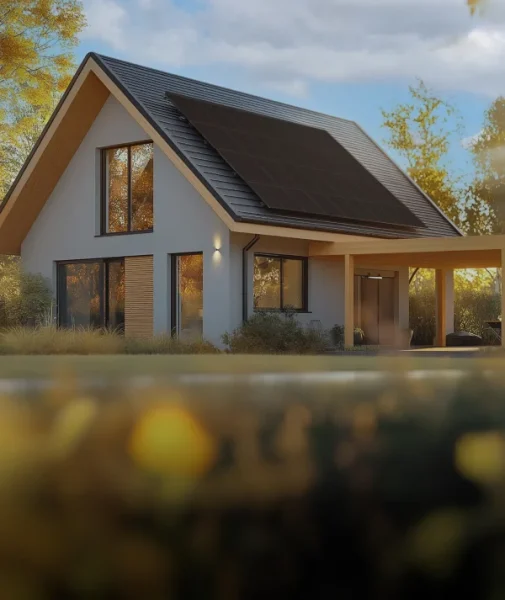
A small-scale solar power plant is a system usually installed on a building rooftop, the roof of an industrial shed, a carport, or small grounds. It converts solar radiation into electricity via solar panels.
Depending on the design and the contract model, this electricity can be used in one of the following ways:
- Internal consumption of the building or facility
- Injection into the electrical grid
- A hybrid model of consumption and sales
- Development specifically for selling electricity via Guaranteed Purchase (Feed-in Tariff) contracts
Therefore, these power plants are considered a significant economic and practical solution for retail consumers, small investors, property owners, commercial units, and applicants for support and guaranteed-purchase programs.
Small-scale power plants: A reliable investment with guaranteed electricity purchase
In the small-scale power plant model, the focus is on utilizing unused spaces such as home rooftops, industrial sheds, workshops, small commercial buildings, and limited land areas.
Beyond the ability to supply a portion of required electricity, these projects can also be viewed as a low-risk, productive investment opportunity.
In projects based on guaranteed electricity purchase (Feed-in Tariffs), the owner can supply the electricity produced by the power plant to the grid based on relevant regulations and contracts, and benefit from a continuous income stream. This model is a particularly attractive and viable option for those who possess suitable space but have limited electricity consumption.
Key benefits of residential, rooftop, and small-scale power plants
Using solar power at this scale is not just an environmental choice; it is also a technical, economic, and investment-oriented decision.
Key advantages:
- Optimal use of unused rooftop or land space
- Reduction in electricity costs
- Potential for revenue generation from electricity sales
- Creation of a productive, long-term asset
- Increased relative independence in energy supply
- Reduced dependency on electricity cost fluctuations
- Increased technical and economic value of the property
- Reduction in pollution and movement toward clean energy
- Low fuel requirement and limited operational costs
- Faster execution compared to large-scale projects
Benefits of guaranteed purchase (FiT) and support projects
In projects implemented with the goal of selling produced electricity, several important advantages are notable:
1) Revenue generation from produced electricity: In this model, the electricity is not merely for internal consumption and can be defined as an income source.
2) Economic use of dead space: Rooftops, shed roofs, or small plots of land that were previously unused become income-generating production units.
3) Suitable scalability: These projects are typically executed at lower capacity ranges, making it easier for many owners to enter the solar energy sector.
4) Faster implementation speed: Due to the more limited dimensions of the project, the process of design, procurement, installation, and commissioning is often faster than in large-scale power plants.
5) Appeal to retail and semi-retail investors: This model is attractive to individuals, property owners, small businesses, and local investors looking for a lower-risk and more manageable project.
Which spaces and buildings are suitable for these power plants?
Residential, rooftop, and small-scale power plants can be implemented for a diverse range of applications, including:
- Residential homes
- Villas and garden-villas
- Residential complexes
- Office buildings
- Small commercial units
- Industrial sheds and workshops
- Schools and service centers
- Public buildings
- Small plots of land with appropriate access
- Rural or suburban applications with installable space
Successful project implementation depends on the following factors:
- Useful installable area
- Orientation and angle of radiation
- Shading levels
- Structural status and roof strength
- Electricity grid connection capacity
- Grid connection conditions
- Purpose of the project (consumption vs. investment)
Fundamental design: The most important success factor
In rooftop and small-scale power plants, correct design is of paramount importance. Each project must be defined according to the real conditions of the site, consumption patterns, structural limitations, and the employer’s economic goal—not based on a generic or repetitive template.
The following items are important in designing these systems:
- Precise survey of usable space
- Shading analysis during different hours of the day
- Selection of appropriate plant capacity
- Panel layout design for maximum production
- Selection of equipment matching climatic conditions
- Compliance with safety and structural requirements
- Forecasting cabling routes and protection equipment
- Technical feasibility for grid connection
- Forecasting appropriate access for service and maintenance
Raham Group, with an engineering view of these details, strives to design and execute every system with maximum operational efficiency, safety, and minimal execution risk.
Raham Group’s role in residential, rooftop, and small-scale projects
In this sector, Raham Group does not limit its services to the sale of equipment. Instead, with an engineering and operational approach, it covers the entire project process from initial assessment to operation and maintenance.
In small-scale and rooftop projects, we design the solution tailored to the type of application, installation conditions, investment goal, required capacity, and technical grid connection requirements.
Raham Group services in this sector:
- Specialized initial consulting
- Technical assessment of the installation site
- Economic feasibility and initial project estimation
- System design tailored to the roof, shed, or land
- Procurement of panels, inverters, and main/auxiliary equipment
- Design and execution of mounting structures tailored to the roof or ground
- Installation of structures, panels, inverters, and electrical equipment
- Execution of cabling, switchgear, and protection equipment
- Installation and commissioning
- Performance testing and technical handover
- Assistance in executive processes and project-related coordination
- Repair, maintenance, and support services
Reliable equipment supply and execution
Equipment quality plays a decisive role in the useful life and performance of a solar power plant. For this reason, in residential, rooftop, and small-scale projects, correct equipment selection and standardized execution are among the most important factors for the long-term success of the system.
Raham Group, as the designer, supplier, and executor of the project, provides the necessary services for the correct selection and implementation of the main components, including:
- Solar panels
- Inverters
- Mounting structures
- Protection equipment and switchgear
- Cables and connectors
- Monitoring and tracking equipment (if needed)
If you need to review related equipment and products, some solutions and items can be tracked via the Raham Group store:
www.Rahamco.com
Maintenance and post-execution support
Although residential, rooftop, and small-scale solar power plants require less maintenance than many other energy systems, periodic inspection and servicing are essential to maintain efficiency and increase equipment lifespan.
Support and maintenance services can include:
- Periodic visits
- System performance checks
- Inspection of connections and protection equipment
- Checking actual production compared to design capacity
- Troubleshooting and bug fixing
- Cleaning and maintenance as needed
Raham Group can also be by the client’s side as the technical partner for the project in this section.
Why Raham Group?
Choosing the right executor for solar projects is as important as choosing the equipment. Raham Group, relying on technical knowledge, operational experience, and supply capacity, strives to execute residential, rooftop, and small-scale projects with a professional, safe, economic, and reliable approach.
Advantages of working with Raham Group:
- Engineering and project-oriented perspective
- Providing services from design to execution
- Procurement of required project equipment
- Principled installation and commissioning
- Post-execution support and maintenance
- Focus on quality, efficiency, and system durability
- Simultaneous attention to both consumption usage and investment models via electricity sales
Learn more about Raham Group services
To learn more about specialized services, execution solutions, and engineering capabilities of Raham Group, you can visit the main company website:
www.RahamGroups.com
Also, to view related equipment and products, the Raham Group store is available at: